![[personal profile]](https://www.dreamwidth.org/img/silk/identity/user.png) furtech
furtech
This hot, humid summer following a -very- wet winter had led to the usual bug-boom. My yard is filled with zillions of ahnts! (as Roz would say). And their conga-lines aren't the usual two lanes: these are 6-10 lanes wide! The yars is swarming and I've had to be extra-vigilant to keep them from getting into the house! Mind you, compared to fire ants these Argentine ants are merely a nuisance, but still a pain. I can't imagine not being able to walk barefoot on grass because of fire ants, or being swarm-attacked by them. (And all those poor pets!) Ech.
On a recent dogwalk, Roz mentioned that she'd seen some show that speculated that the Argentine ants (little black ants) are so prevalent because they're all descended from the same original queen, making them one, huge super-colony. In other words, their population isn't checked by inter-nest fighting/competition: ants from one nest-- if displaced-- can just move into the nearest colony. I wonder why no one has tried to introduce a new Argentine queen to the area? Or have the local ants already evolved into this new nature?
The spider situation is, oddly, not as bad as in previous years. There are still webs on the path, but not nearly the explosion I expected this year. Larry/Andrea: are you guys having a bumper spider year?
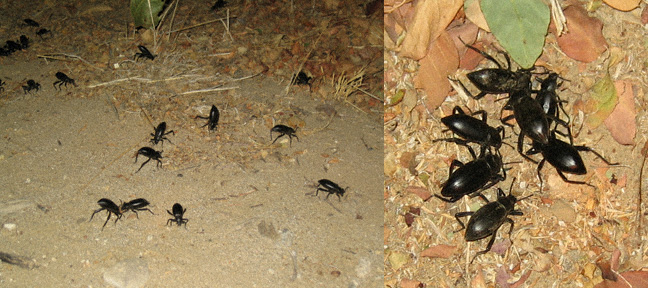
Darkling beetles are an interesting (to nature geeks like me) conundrum: They're *everywhere* on the trails, easily visible (shiney black on dusty trails), don't seem to have any natural enemies (except for bikes and human feet) and don't seem to pose any kind of threat. So visible, yet so innocuous that nobody seems to have studied them: even the "Insects of L.A." book (the bible for bugs here) essentially says that "little is known about the life cycle of the darkling beetle." And this book has oodles of information on nearly every other insect here!
However, now Roz and I know a *bit* more about them: this is apparently their mating season! While on a solo dogwalk I heard rustling in the leaves: too small to be toads, I flashed my light and saw dozens of darkling beetles scuttling about in a large group. Creepy. And their butts were in the air-- the position they normally take when defending themselves (they squirt out some noxious fluid). Apparently this is also a pheromone, as many of them were in this position despite the lack of nearby threats. I still can't tell which is the male or female: the larger of the beetles is usually the female (according to Roz), but that's also the one that seems to have its butt airborne.
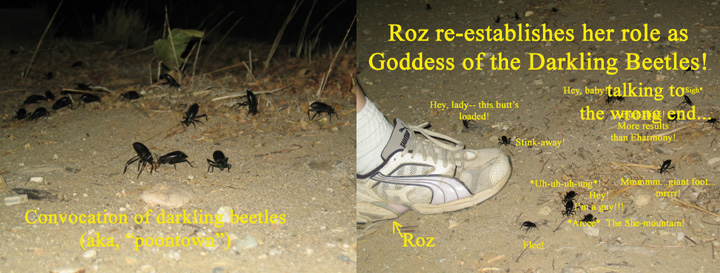
.Here's a large version of the picture above, showing an area where the darklings were gathering and an intense grouping of beetles
Mighty Zor! lends her foot for a size reference, with commentary


![[identity profile]](https://www.dreamwidth.org/img/silk/identity/openid.png)
no subject
Date: 2005-08-07 08:05 am (UTC)no subject
Date: 2005-08-07 12:48 pm (UTC)no subject
Date: 2005-08-07 09:15 am (UTC)There is a guy slated to be killed who's been making his web 3 inches in front of the sliding glass door in the family room, but we've so far settled for not using that door.
no subject
Date: 2005-08-07 12:51 pm (UTC)no subject
Date: 2005-08-07 01:14 pm (UTC)It's like once they have picked a web spot, that's it, they consider it theirs forever. We tend to leave them be unless they are in high traffic areas.
no subject
Date: 2005-08-07 11:42 pm (UTC)no subject
Date: 2005-08-07 09:58 am (UTC)That's the official name ah? wow!
Date: 2005-08-08 02:13 am (UTC)We've always just known them as 'stink bugs' over here... to be avoided in order to avoid that annoying odor... ;P
no subject
Date: 2005-08-08 02:14 am (UTC)A few weeks ago there were Zillions of ladybugs along a stream trail I visited in Mt. Baldy... in clumps even!
no subject
Date: 2005-08-08 05:42 am (UTC)